Česky
Česky


What should I take with me for an MRI scan?
- a referral form from the referring physician for the MRI scan
- health insurance card
- copies of the findings of previous examinations, if the patient has undergone them at other institutions
- medical imaging documentation from another healthcare facility, sent electronically using the ePACS system or stored on a CD
- comfortable clothing without metal objects and socks (recommended)
How to prepare for an MRI scan?
examination of the abdominal area ( intestines, bile ducts, liver) - do not eat 2-3 hours before the examination
small bowel examination ( MR enterography) - avoid bloating 2 days before the examination and fasting on the day of the examination
other examinations - no special preparation is needed, you can take your usual medication unless your physician advises otherwise.
Informed consent for an MRI scan
- Please arrive approximately 20 minutes early for your appointment in order to be briefed about your scheduled MRI scan.
- You can also download the instructions HERE(IS_NH_AP_01_Magnetic_resonance) or for the whole body MRI HERE ( IS_NH_AP_02_Magnetic_resonance_whole_body ). When you arrive for the examination, you will be personally briefed by the radiology assistant who will be performing the examination.
- If you have any concerns or questions, please communicate them to the staff before the actual examination begins.
- As part of the briefing, we will ask you to give your informed consent for the MRI scan, which you will confirm by signing. By agreeing, you acknowledge that you have been informed of the examination procedure, risks and contraindications.
How is the MRI scan performed?
- After signing the informed consent, you will be ushered into a cubicle where you will be asked to remove your clothing according to the area to be examined (a disposable gown will be provided to cover you) and any metal objects that must not be in the magnetic field: Dentures, hearing aids, contact lenses, prosthetic devices, underwear that includes metal, belts, wigs, hairpins, tweezers, pins, clips, metal coins, keys, watches, credit cards, glasses, cell phones and jewelry. It is advisable to leave valuables at home. In the case of certain specific examinations, you may be asked to remove your make-up. This also applies to your companion if he/she will be with you in the examination room.
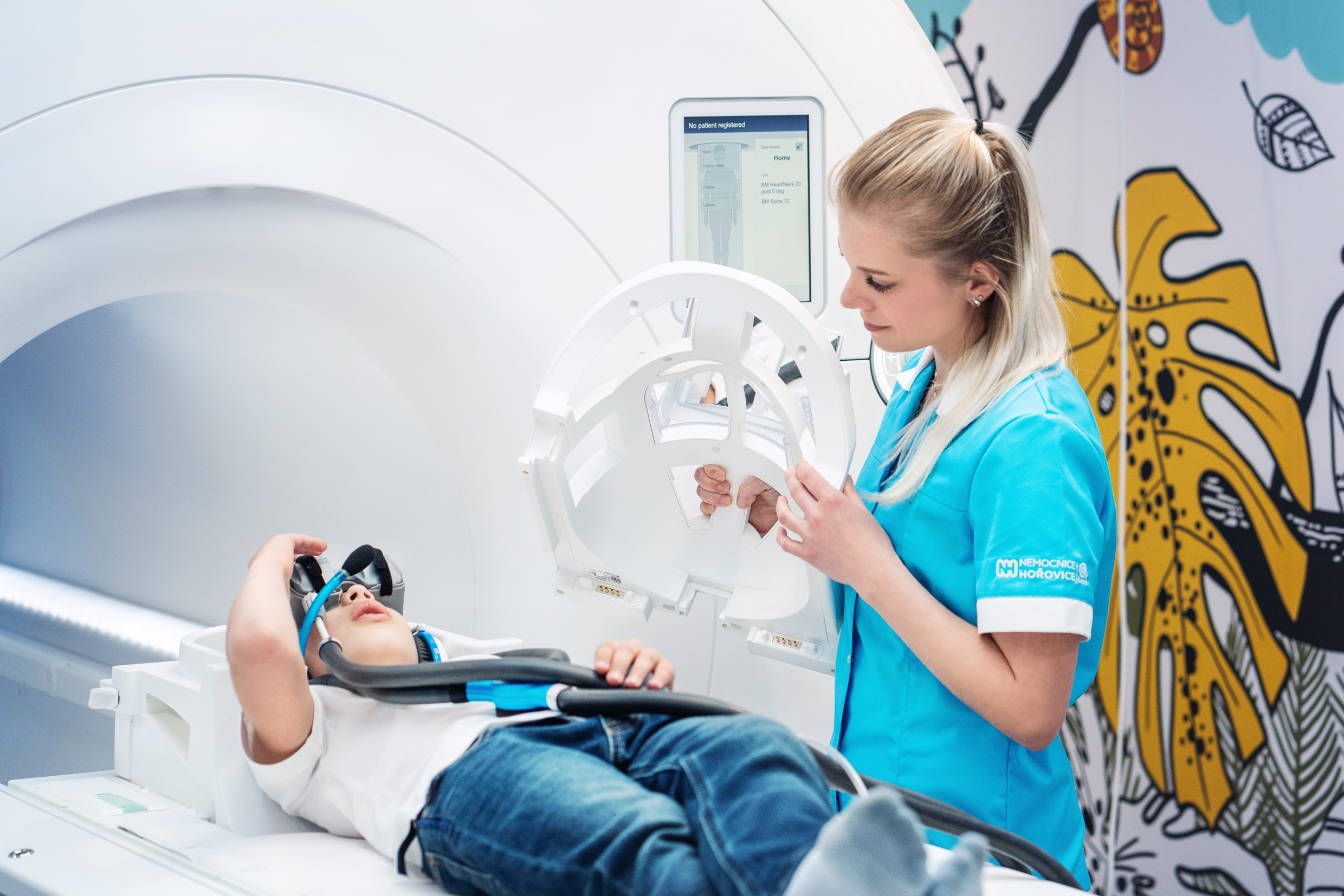
- The radiology assistant will then usher you into the examination room with the magnetic field, place you in the examination position on the bed, which is inserted into the machine so that the area to be examined is in the middle of the MRI ring.
- During the examination, lie still and breathe regularly (any movement you make may invalidate the examination).
- In addition, you will be asked to hold your breath at various intervals during the chest and abdominal examinations.
- Throughout the examination you will have a button in your hand that you can use to summon the operator; the MRI staff will be in contact with you via a microphone.
- The examination itself is completely painless.
- During the examination, the MRI machine makes an intense noise. You will be given earplugs/headphones before the examination begins.
- The length of the examination varies according to the area being examined, most often lasting 20 to 30 minutes.
- As a standard, medical descriptions for MRI examinations are completed and delivered to the attending physician within one week of the examination.
Post-procedure regimen?
- If you are administered a contrast agent, please wait in the waiting room for 30 minutes after the examination is completed due to a possible allergic reaction to the contrast agent. In the following 24 hours, drink enough to help the contrast medium to be eliminated from the body more quickly.
- Breastfeeding mothers should discontinue breastfeeding for 24 hours after the examination.
- During the examination of the pancreas, prostate and small pelvis, you will be given the drug Buscopan. You may experience eye movement disorders or dizziness after taking it. In such cases, you must not drive a car or perform other potentially dangerous activities (operating machinery, working at heights) until normal vision is restored, which takes approximately 12 hours. In these cases, we recommend accompanying the patient.
When is it not possible to have an MRI scan?
Patients cannot undergo the examination:
- with a pacemaker or defibrillator in place,
- who have electrodes left behind after removal of the pacemaker or defibrillator,
- with electronic implants ( cochlear implant, insulin pump, neurostimulator, etc.).
- with vascular clips in the brain ( unless the neurosurgeon confirms that the material used is compatible)
- with metal foreign objects in the eye ( splints)
- The examination is not normally performed in the first three months of pregnancy.
In all of the above cases, inform the MRI staff immediately!
Address of the MRI department:
Coral Office Park - Building A
Bucharova 1281/2
158 00 Prague 13 - Nové Butovice
www.akeso-policlinic.cz
recepce@AKESO POLICLINIC.cz
How to reach us?
AKESO POLICLINIC is a medical outpatient clinic easily accessible by public transport:
- it is located just a few steps from the Nové Butovice metro station (line B),
- on the ground floor of building A of the Coral Office Park,
- parking is available in the OC Galerie Butovice,
Thank you for your understanding.
The staff of the MRI department is looking forward to meeting you.