Česky
Česky


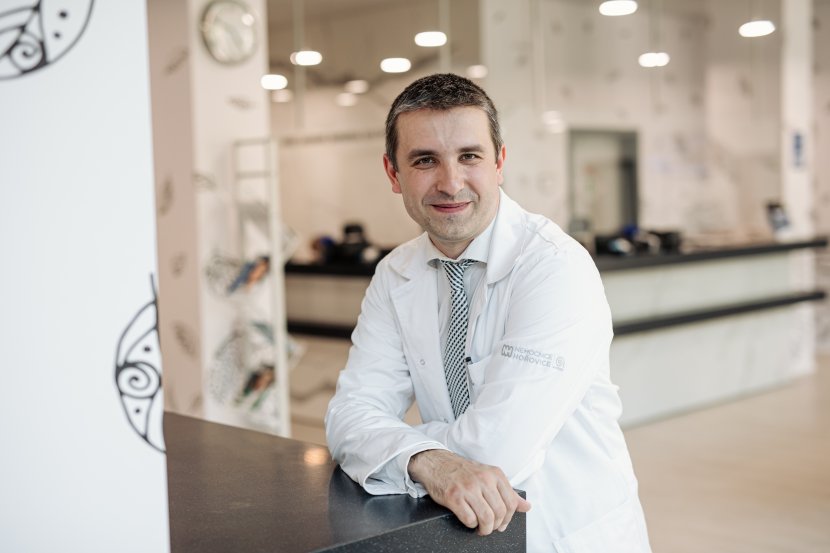
Jiří Trčka is a paediatric surgeon working at the Motol Hospital and specialises in paediatric urology. "It's an interesting field that allows a paediatric surgeon to solve many of the problems he encounters in his services without having to call someone else to do it," he says. He always wanted to work with children, and surgery was an obvious choice in school. After his surgical certification, he found urology to be an interesting field with a future. "As one of my chairmen emeritus used to say, 'Treating a child is more important than treating an adult because you can actually cure a child.'"
Trcka said there are also fewer burnouts among pediatric physicians. "When you treat adults, they often come to you with problems that they somehow caused themselves, and now you have to treat them, but you know it's pointless because they'll do it again. That wears a person down over time. When you're a pediatrician, you can't be angry with your patient. You can be angry at his parents, but not at the child - and that just keeps you from burning out," he explained.
What problems can clients turn to you for?
Basically all urological problems. We deal with congenital genital developmental defects, undescended testicles and foreskin problems in boys. We also see pediatric patients with congenital developmental defects of the kidneys and ureters. Most often, we see clients with enuresis, incontinence, phimosis, testicular retention, and adolescent genital disease. We perform a basic diagnosis, and if we find that further care is needed, we refer them to specialized departments.
What instruments does the diagnostic centre in Butovice have at its disposal?
We have an ultrasound with which we are able to diagnose dilatations of the hollow kidney system, diseases of the bladder. In the near future we will have a uroflowmeter. This is a basic diagnostic device that, together with the micturition card examination, allows us to diagnose functional excretory disorders.
What makes pediatric urology specific?
The breadth of its scope because, like any other pediatric specialty, it deals with children from the first day of life until the day we hand them over to adult urologists. Even some problems can be diagnosed in the prenatal age. This is the case, for example, with dilatations(inappropriate enlargements) that are visible as early as week 20 on a large ultrasound. Sometimes it happens that the problem is fixed in the prenatal period and no surgery is needed, and in some cases surgery can be done in the prenatal period(in the mother's abdomen).
How does the approach to paediatric patients differ from that to adults?
It is different at least in the fact that you have to get the family on your side, because the pediatric patient is not going to treat himself, he needs motivation and supervision. And you often have to get two or three people on your side to cure one patient. You can't do pediatric urology without parental involvement. Everything needs to be explained in an age-appropriate way so that not only adults but also children understand. For example, we use stuffed animals to show how we are going to treat the pediatric patient. You always want to communicate with the patient and the family so that you can see how they react, so that the doctor can see the background and take the right approach to explain everything.
I have even had some children not cooperate until we handed over responsibility for their treatment. So I made an agreement with the patient that I would explain to him what to do and he would do it under my supervision. The kids functioned without stress after that.
"You can't do pediatric urology without parental involvement."
Where do you refer your patients who need some kind of therapy that the outpatient clinic can't handle?
For the simple ones, we cooperate with the paediatric department at Hořovice Hospital, of course, and if it is a more complex case(for example, various cleft defects), we cooperate with the relevant departments at Motol Hospital, or parents can arrange treatment elsewhere on our recommendation.
Find out more about the paediatric urology clinic in our centre or book an appointment via the online form.
Source: Barbora Mráčková