Česky
Česky


What diagnoses do you deal with in your outpatient clinic?
I focus primarily on children with respiratory disease or postural defects. I also specialise in gynaecological physiotherapy. This addresses the problems of women who have, for example, menstrual cycle disorders, have severe menstrual pain or even various pains during pregnancy. In the past I have also worked with cancer patients who suffer from swelling as a result of surgery or radiation.
How old are the children in your care?
I take care of children as young as three years old who can already cooperate. It is also important to work with their parents, who have to do the recommended exercises with them at home.
What problems do adults most often come to you with?
A large number of patients come with acute pain - now mainly shoulder or leg pain. But at the same time, I have patients here after various abdominal and orthopaedic surgeries and pregnant women.
After which surgeries is it advisable to undergo physiotherapy?
In the Czech Republic, it is not standard to send a patient for rehabilitation after abdominal surgery, and there is a lack of education to encourage this. For example, after laparoscopic surgery, when you have only a few small scars on your body, you need to look at the quality of the tissues, because there may be adhesions in the future.
What kind of problems do pregnant women come to you with?
I deal with various back pain, headaches or swelling of the limbs in pregnant women. I also have patients come in who want to make sure they are moving properly and not hurting themselves in pregnancy. Movement, if the doctor allows it, is very important in pregnancy.
What instrumentation do you use most often?
I use a variety of electrotherapy, magnetotherapy and ultrasound as part of my rehabilitation. I now have the opportunity to use TR therapy, which is a high frequency electrical therapy that can help and relieve muscle tension. It's a newer machine and I think that after injuries where there is swelling or bruising, or after a lot of exertion, it can relieve pain and ease muscle tension. A couple of sessions are enough for the effect. For me personally, this machine is a small miracle.
However, you also offer manual treatment techniques.
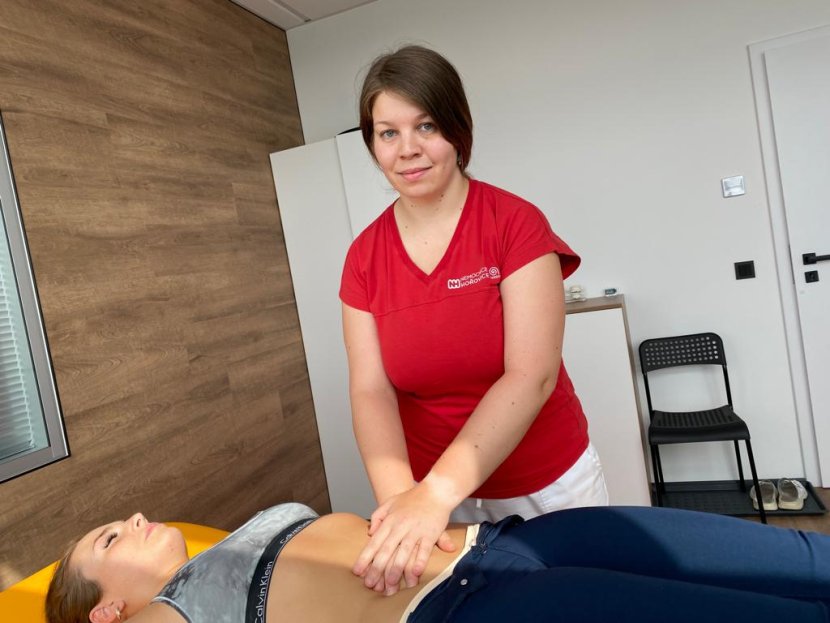
Yes, I work with manual lymphatic drainage, soft techniques and visceral manipulation. The latter is used to relieve tissue tension, ligaments and blood flow to the organs. It is important that the organ is mobile, sufficiently nourished and that this information is transmitted to the brain. If these conditions are not met, there is a change in function and our body may send signals of pain, tension and discomfort.
This tension may well be caused by some inflammatory processes within the body or even old scars (for example, after appendectomy) that can create various pulls.
During my treatment I look for the biggest tension, which I use gentle techniques to try to release.
The treatment is suitable for patients suffering from various digestive and inflammatory problems, gynaecological problems, breathing difficulties or movement problems that are recurring and may be related to organ tension.