Česky
Česky


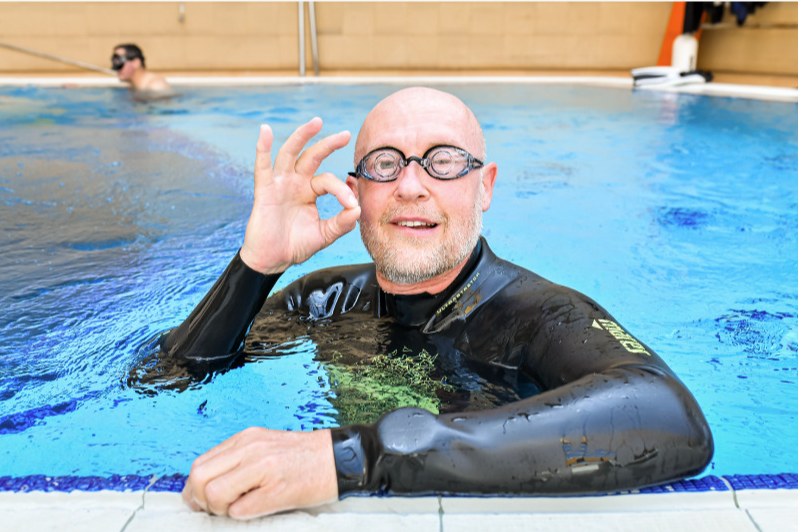
Your specialty is prenatal diagnostics. Why did you choose this field, what fascinates you?
This work is probably most in keeping with my nature. You could say that I got into the field in a roundabout way when I couldn't work in Slovakia. In Hradec Kralove I worked under the guidance of a top expert, thanks to whom I got into the field.
Prenatal diagnostics is a relatively young field, extremely fast developing. Do you always have to learn something new?
Of course you do. You can see a huge shift in technology in genetics in general. Compared to orthopaedics or surgery, the progress is brutally noticeable. At AKESO POLICLINICE, we also offer our patients expert ultrasound or the much-mentioned prenatal diagnostics, which are definitely not offered by every medical facility. It takes 10 to 15 years to learn. I don't want to sound arrogant, but I've been doing ultrasound since 2006, so 17 years. When there's a plane crash somewhere, it's often mentioned how many hours the pilot has flown. In that sense, when you've done about 40,000 ultrasounds, you could say...
...you've flown a lot!
Yes, in this case, a lot of flying time. You develop a sixth sense. If you don't like a screening result, you send it on and catch the defect in time, even though it could easily have been missed. There is a recommendation from the diagnostic ultrasound section that a superconsillar ultrasound at 20 weeks gestation should take 20 minutes. There are facilities where it takes 5 minutes. I can do it in 3 to 4 minutes, but I'll blow it off, which I don't want to do. Patient comes first for me.
In the private gynaecology practice you run alongside our clinic, you work with your wife. Don't you feel that you can't avoid work at home when discussing work issues?
Just yesterday I was on a boat on the Vltava River with my wife and I told her about a case. She responded that she'd ruined her evening because she was going to think about it. But I couldn't not tell her. So, yes, work affects our private lives. I think even architects and other professions don't slam the door on work after hours.
Your hobby is freediving, which is diving without a breathing apparatus, where you hold your breath above the surface. How did you get into it when we don't have ideal conditions for it in the Czech Republic?
About seven years ago I discovered a freediving shop in Holešovice and its owner, coach and Slovak diving record holder, all in one person, Martin Zajac. I was intrigued that freediving, which Martin drew me to, was a great way to clear my head. I, a turbo, don't know how to do that. I don't know how to switch off, so to speak. I've developed hypertension due to my past workload and constant stress. A good friend and cardiologist who is looking after me suggested that I deal with it with Neurol (a drug to reduce mental tension, including depression), and I decided that I'd rather deal with it by freediving, and started going to training sessions.
You were born and lived in Tunisia as a child, you probably have a lot of experience with the sea...
My father used to take me out on the boat and I saw things like flying fish flying into our boat. It was an experience. I like to say that I've been freediving since 1969, when I was born. At a time when there wasn't enough awareness of it among people. Water calms me down and I've always had it around me. Even when I was studying medicine in Bratislava, I was canoeing on the Danube. I fought the current, I felt the power of the water and I enjoyed it.
I thought that freediving was about adrenaline, but when I studied more about it, I found that it is instead about absolute relaxation, close to meditation. How do you feel about it?
It's the exact opposite of adrenaline. When we were in Egypt, training deep-sea diving in the open sea, I had the opportunity to improve. Our training pool in Pruhonice is only 8 metres deep. I reached 15, 16 meters at first, but I felt I was struggling. I couldn't do it. Then when we were training in Poland, I cleared my head and suddenly I was at 26 metres, and I didn't understand how. I went into nirvana. I wanted to go further and deeper because I felt like I had suddenly figured it out. But I preferred to climb out because I knew I might have a problem with the coach. You don't stop at the bottom, but you still have to dig up above the surface. There's no elevator waiting for you at the bottom. You can't freedive by force. If you do, you'll burst your eardrums, injure your lungs or tear a muscle. There's a lot of pressure on your body at depth, so you need to be well warmed up.
Does the depth hurt?
I've never been at such extreme depths that I've felt pressure on my chest. But I have to be able to balance the pressure in my ears. You can do it at shallower depths by pinching your nose and pushing air to your eardrums, but freedivers can do it in other ways, like pressing their tongue to their palate, called Frenzel.
What kind of equipment do you need for your diving? I can think of a wetsuit, fins and a mask. Anything else?
You basically listed it. A wetsuit is needed for extended training because even in warm water at 28 degrees Celsius, the human body loses heat. Freediving fins are used very long, preferably carbon, which give you better amplitude on the kick and move you better. Then a low-volume mask. It has minimal space in front of your eyes. When you dive, you equalise the pressure in the mask by exhaling into it through your nose, otherwise the vacuum in it will "suck" out your eyes. I've also tried special fluids, which are goggles that you scoop water into. The optics are designed differently in these because there is refraction of light at the interface of the two environments. You also need a nose clip like aquabelles use. You can still use a weight belt. As long as you don't use a breathing apparatus. Divers with breathing apparatus are able to be underwater for tens of minutes at various depths. It's just that they can get into trouble when their mechanics go wrong. We freedivers can't have any mechanics go wrong, because we don't have any. We just work with our bodies like an opera singer works with his voice.
Do you think of diving as a sport or more like meditation?
Both. It's a sport that can be done at the top level. But you don't need strength to control your body so much as you need strength to work with your breath. Of course, it's also about self-discipline. If you smoke, you're a fool because you don't inhale as much.
You mentioned the importance of a partner. Is it possible to do freediving individually or is it a team?
Training is team-based, you can't afford to rent the whole pool. When we go abroad, it's in a group. And when you dive on a line (a rope leading down from the surface that you can handline), you're always in a group of two. It's extremely important to have a buddy, someone to watch over you. Often you are going to your limits. The buddy is up by the line, looking down below the surface with the snorkel in case something happens. Then he'd dive in behind you. That's why we had to take what's called safety training, loosely translated as lifeguard training, as part of our freediving certification. You learn how to pull a person out of the water who's faking unconsciousness. It usually happens when you're surfacing when you're low on oxygen.
What's more important to you in freediving? The time you can stay underwater in one breath, the depth you reach, or the calming of your mind?
You have to be careful not to go for records. I've found that the more I calm down, the easier it is to give that depth. It's no good if you're pushing it. I'd be lying if I said I didn't try testosterone (an anabolic steroid) after 50. I wanted to get better results in cycling, which I've been doing since I was young. I wanted to push myself, but the bottom line is it turns against you. I understood that it's not about pissing your body. You have to learn to listen to it and understand it.
Do I feel right that both freediving and the sport in general teaches you humility?
Terribly. When you're in the sea, you feel this tremendous power. That's where you know you're nothing. If you don't surrender to the water, it will slap you. I'm also tempted to get more into meditation. To learn to unblock your head, because it's going against you. Not just in the water.
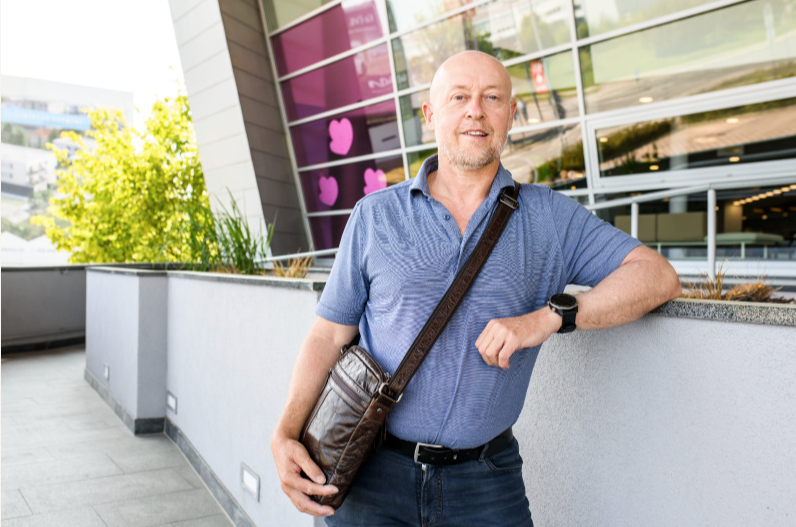
Peter Plevak, M.D.
He grew up in Tunisia until he was seven years old, before he moved with his parents to Bratislava. He graduated from the Medical Faculty of Comenius University and gained his first work experience in Banská Štiavnica and Galanta. He then went to work in the Czech Republic. In 2005, he started working at the Gynaecology and Obstetrics Clinic at the University Hospital in Hradec Kralove, where he got into ultrasonography. Since 2016 he has his own gynaecological practice, which he runs with his wife, also a doctor. As an expert in prenatal diagnosis and birth defects, he established a closer cooperation with AKESO POLICLINIC in 2023. He is a passionate cyclist and, in recent years, a freediver.